Posts

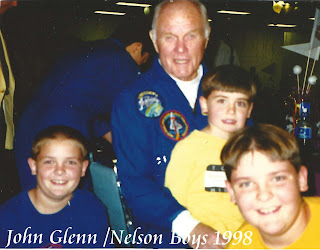
Meeting John Glenn

Image
On December 8, our oldest son informed our family of John Glenn's passing. Our youngest then reminded his brothers that he was the one who got to sit on the famous astronaut's lap. One of the best ways to develop leadership potential in youth is to introduce them to great leaders. This could be as simple as an interaction with your boss or pursuing a photo op with a famous leader. These interactions create a comfort level with people of power and often inspire them to emulate the same attitude.  The idea that children should be seen and not heard is fading in most families. But it's a step further to provide positive interactions with influential leaders, even going out of your way to make this happen. If the leader balks at the opportunity to meet your kids, then chances are s/he wasn't worth meeting anyway.
Image
Engaging Millennials in Leadership As millennials (born approx. 1980-2000) pour into the workforce, many of them are taking on ample responsibilities, especially as boomers retire in droves.  Responding to cultural differences of this generation is vital for those of us older.  Here's an article I wrote for L.A. Biz on how the senior vice president of human resources for the LA Clippers NBA franchise develops young leaders. Click HERE .

Defining Leadershp

Image
While Tuesday's election is a vivid example of why we need to do a better job, raising more and better leaders from early ages, another issue has to do with what we expect from our leaders. I wrote an article for L.A. Biz that explains the need to clearly define what we mean by leadership when we talk about it. Click HERE to read this short article.

The O Factor

Image
The O Factor, a book on leadership ability among 2-22 year olds, offers a very unique look into what gives less than 10% of students such an exceptional ability at influencing others.  Organizational leadership talent is quite different than other domains of giftedness such as academics, art, creativity, and physicality.  Wouldn't it be interesting if we could identify future CEO's, presidential candidates, and entrepreneurs, decades before they're formally recognized?  Well, we can; getting to them while they're pliable in their morality and cognitive abilities. The "O" in The O Factor stands for organization, the ability to get others to achieve together what they would not or could not as individuals.  You can see it on the soccer fields, in school lunchrooms, and local neighborhoods.  Leadership ability is recognized by the US Department of Education and 15 US states as a domain in the field of gifted and talented education, yet practically nothing has...

I'm an Iconoclast

Image
Iconoclast : a person who attacks cherished beliefs, traditional institutions, etc., as being based on error or superstition. a breaker or destroyer of images I do not believe that everyone can become a leader, if you define leadership as the ability to accomplish together what you cannot as individuals.  I do not believe that leaders are all adults, meaning that people as young as 3 lead and as young as 10 can be taught to lead with sophistication.  I do not believe that people who understand youth, understand leadership and those who understand leadership, know how to identify and develop adolescent leaders.  I do not believe that teaching gifted and talented students how to lead is the same as identifying and training students gifted in leadership.  I do not believe that just calling something leadership is actually leadership, in that most school and adolescent "leadership" programs are actually about self-esteem, academics, confidence, character and any num...

From Good to Great Schools

Image
In our upcoming e-news (Q2 2015), I introduce a 1-page brief on the differences between teachers and educators.  I don't mean to be disparaging, but some of the ills we've created in our educational systems, like all corporate, social and civic organizations, is that we've recruited the right people into the wrong places.  Most people I've met in schools, private and public, seem highly committed, motivated, and well-intended.  Certainly exceptions exist, but when we put savvy non-leaders into leadership roles, organizations eventually grow stale, if not implode.  The primary reason that so many schools languish is that they've elevated people with teacher-mindsets into roles of administration.  When you're not interested in learning yourself, hearing new ideas, and exploring with "what if" (educators) the organization will languish.  Good ideas are a dime a dozen, but great ones, the ones possessing th...

The Smartest Leadership Author I Know

Image
In 2015, we launch a SheLead audio series involving 10-15 minute interviews with women leaders, thinkers, authors and practitioners. Being a bit of a leadership geek, I collected over 700 books on the subject.  Obviously, there are a large handful, okay, an armful, of books I devoured; provocative and ah-ha celebrations of new thinking. But recently, my favorite author has emerged as Barbara Kellerman.  She's with the Kennedy School at Harvard University.  Her many books on leadership (Google them or do a search on Amazon.com) have challenged my thinking.  Her contrarian attitude combined with a fine mind, results in a lot of pot stirring for those of us steeped in the literature.  You'll hear from Barbara and others in this upcoming series, featured in this blog and the www.shelead.org website.  Look for it and if you want a good read on leadership, try Kellerman.